

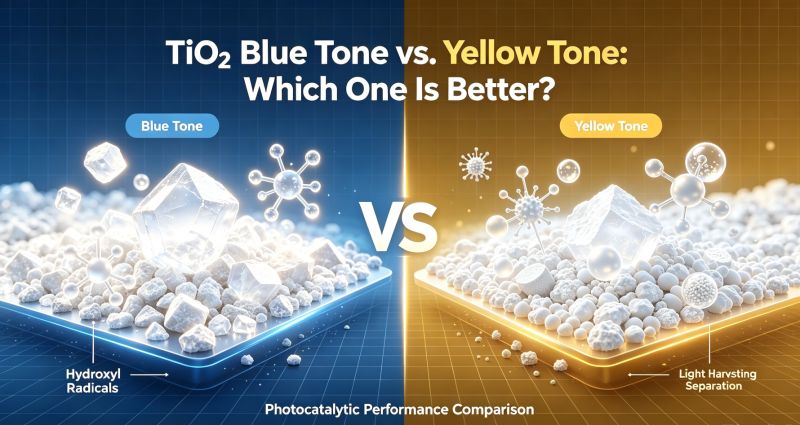
When buying Titanium Dioxide, customers often ask: “Is this grade bluish or yellowish?” But the answer is not simply about which one is “better.”
Bluish TiO₂ usually gives a cooler and cleaner visual white. This is why it is often preferred in applications where a bright, high-whiteness appearance is important, such as white coatings, plastics, masterbatch, inks, and paper.
Yellowish or warmer TiO₂ can provide a warmer white appearance. For some formulations, this may actually be an advantage because the customer needs to match an existing color system rather than achieve the coldest possible white.
This is also why some customers prefer grades such as R996, even when they may perceive the tone as warmer compared with some more bluish grades.
The key point is that blue tone does not automatically mean better quality, and yellow tone does not automatically mean lower quality. Tone is only one part of TiO₂ performance.
In real production, buyers also need to consider whiteness, tinting strength, opacity, dispersion, particle size, oil absorption, processing performance, and batch-to-batch consistency.
For example, a customer producing bright white masterbatch may prioritize a cooler visual tone, while another customer producing a warm-white coating may prefer a TiO₂ grade that works better with their existing formulation.
The better question is not “Blue or yellow?” but “What color and performance does your final product need?”
#TitaniumDioxide #TiO2 #RutileTitaniumDioxide #TiO2Pigment #Coatings #Masterbatch #Plastics #Paints #ChemicalIndustry #RawMaterials
Post time: Sep-17-2026