

Not every TiO₂ application requires extensive surface treatment.
While modern rutile TiO₂ grades often feature inorganic coatings such as alumina, zirconia, or combinations of both, uncoated TiO₂ still has its place in certain industrial applications.
But why?
1. What Makes Uncoated TiO₂ Different?
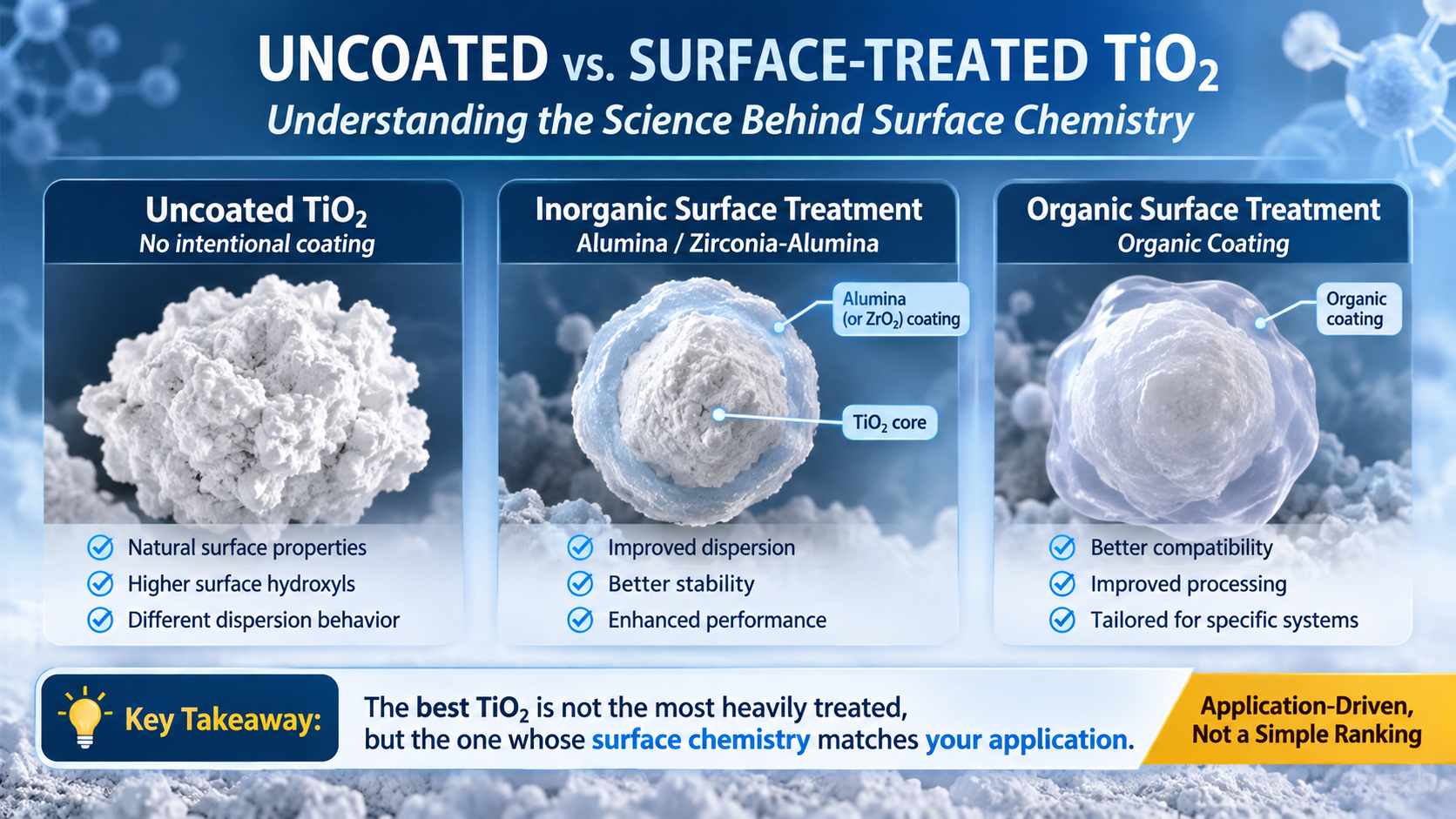
Uncoated TiO₂ has no intentionally applied inorganic surface coating.
Compared with surface-treated grades, it generally has a different surface chemistry, which can influence:
• Surface hydroxyl characteristics
• Moisture interaction
• Dispersion behavior
• Compatibility with different processing systems
However, uncoated does not automatically mean poor dispersion or inferior performance. Particle size distribution, crystal structure, and manufacturing quality also matter.
2. Where Can Uncoated TiO₂ Be Used?
Depending on its production characteristics, uncoated TiO₂ may be suitable for:
• Selected paper applications
• Certain ceramic formulations
• Specialized chemical processes
• Applications where additional surface treatment is unnecessary
The suitability depends on the formulation and processing conditions.
3. Why Is Surface Treatment Important?
In many modern applications, inorganic surface treatments such as alumina and zirconia are used to improve specific performance characteristics.
Organic surface treatments may also be added to enhance compatibility with particular systems.
For example:
1. Alumina treatment: can help improve dispersion and surface characteristics.
2. Zirconia-Alumina treatment: can provide a different balance of surface properties, depending on coating design.
3. Organic treatment: can improve compatibility with selected organic media and processing systems.
These treatments are not interchangeable, and their effectiveness depends on the intended application.
4. So, Is Uncoated TiO₂ Still Relevant?
Absolutely.
The best TiO₂ is not necessarily the one with the most complicated coating structure.
It is the one whose surface characteristics, particle properties, and performance match the actual application.
A more advanced surface treatment does not automatically guarantee better results in every formulation.
The real question is not whether TiO₂ is coated or uncoated, but whether its surface chemistry is suitable for the system in which it will be used.
What is your experience with uncoated TiO₂ in industrial applications?
I’d be interested to hear different perspectives from the industry.
#TitaniumDioxide #TiO2 #SurfaceTreatment #RutileTiO2 #CoatingTechnology #ChemicalIndustry #MaterialScience #Pigments
Post time: Nov-21-2026