

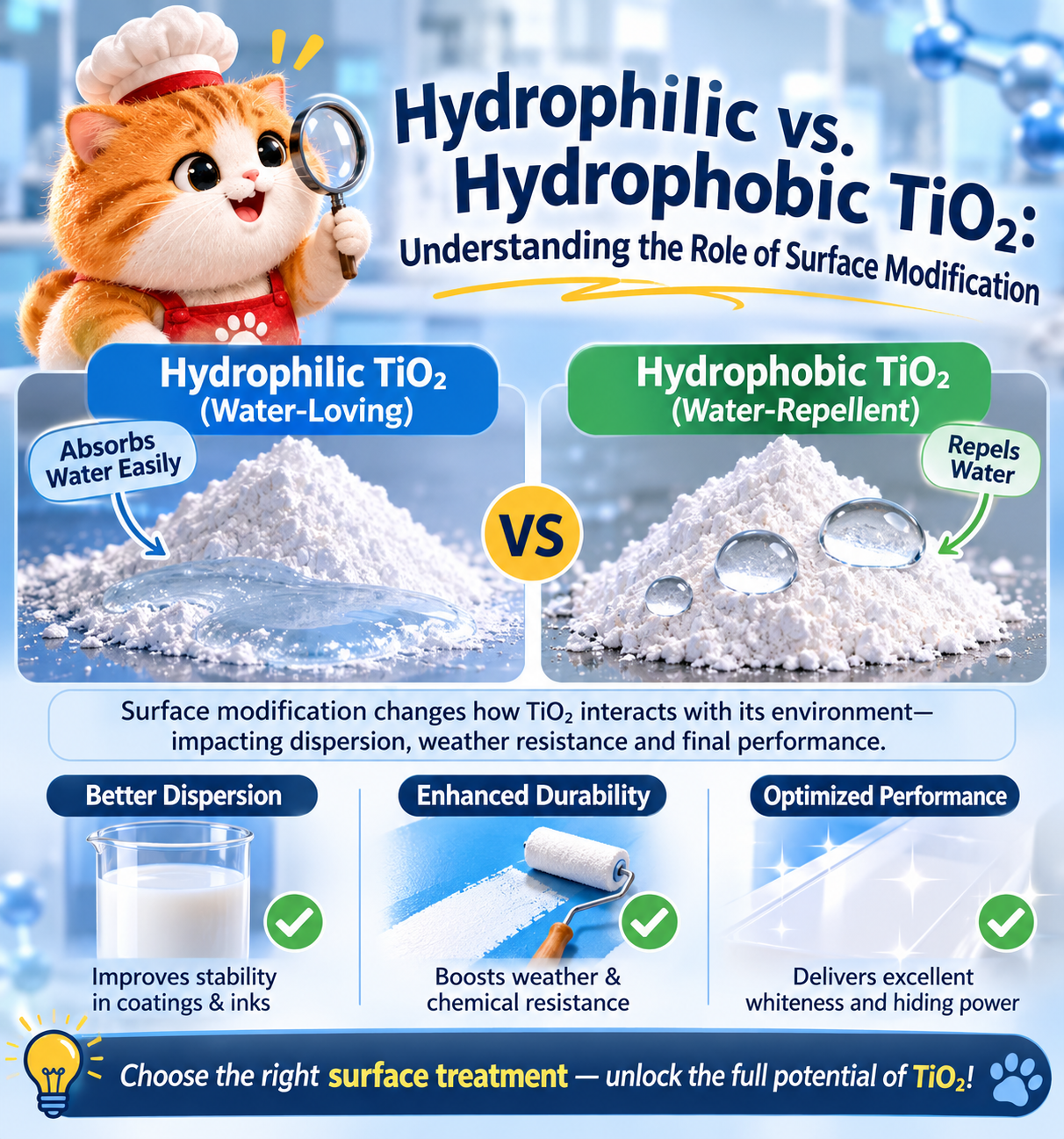
Hydrophilic vs. Hydrophobic TiO₂: Understanding the Role of Surface Modification
Titanium dioxide (TiO₂) is widely used in coatings, plastics, inks and many other industrial applications. But have you ever considered whether its surface is hydrophilic or hydrophobic?
The answer is closely related to its surface chemistry and treatment technology.
1. What Makes TiO₂ Hydrophilic?
An untreated or hydroxylated TiO₂ surface generally interacts well with water. Inorganic surface treatments, such as alumina (Al₂O₃) and silica (SiO₂), can also influence surface wettability, depending on their structure and treatment conditions.
2. What Makes TiO₂ Hydrophobic?
Hydrophobic TiO₂ is commonly associated with additional organic surface modification, such as silane, silicone-based or other organic treatments.
These modifications can reduce the surface’s affinity for water and improve compatibility with certain non-polar or less polar systems.
3. Why Does This Difference Matter?
Surface wettability can influence:
• Water absorption and moisture interaction
• Powder dispersion and wetting behavior
• Compatibility with different resin systems
• Processing performance in coatings, plastics and inks
However, hydrophobicity does not automatically mean better dispersion. The right surface treatment depends on the application medium and formulation.
4. How Can We Identify Hydrophobic TiO₂?
Don’t rely on the product name alone.
Check the TDS for organic surface treatment information, review the manufacturer’s technical specifications, and, if necessary, conduct a water-wetting or contact-angle test.
A small difference in surface chemistry can lead to a noticeable difference in application performance.
The key takeaway:
TiO₂ performance is not determined by whiteness and particle size alone. Surface modification is another important factor that deserves attention.
What is your experience with hydrophilic and hydrophobic TiO₂ in coatings, plastics or ink formulations?
Let’s discuss.
#TitaniumDioxide #TiO2 #SurfaceTreatment #Hydrophobic #Hydrophilic #Coatings #Pigments #ChemicalIndustry
Post time: Nov-24-2026