

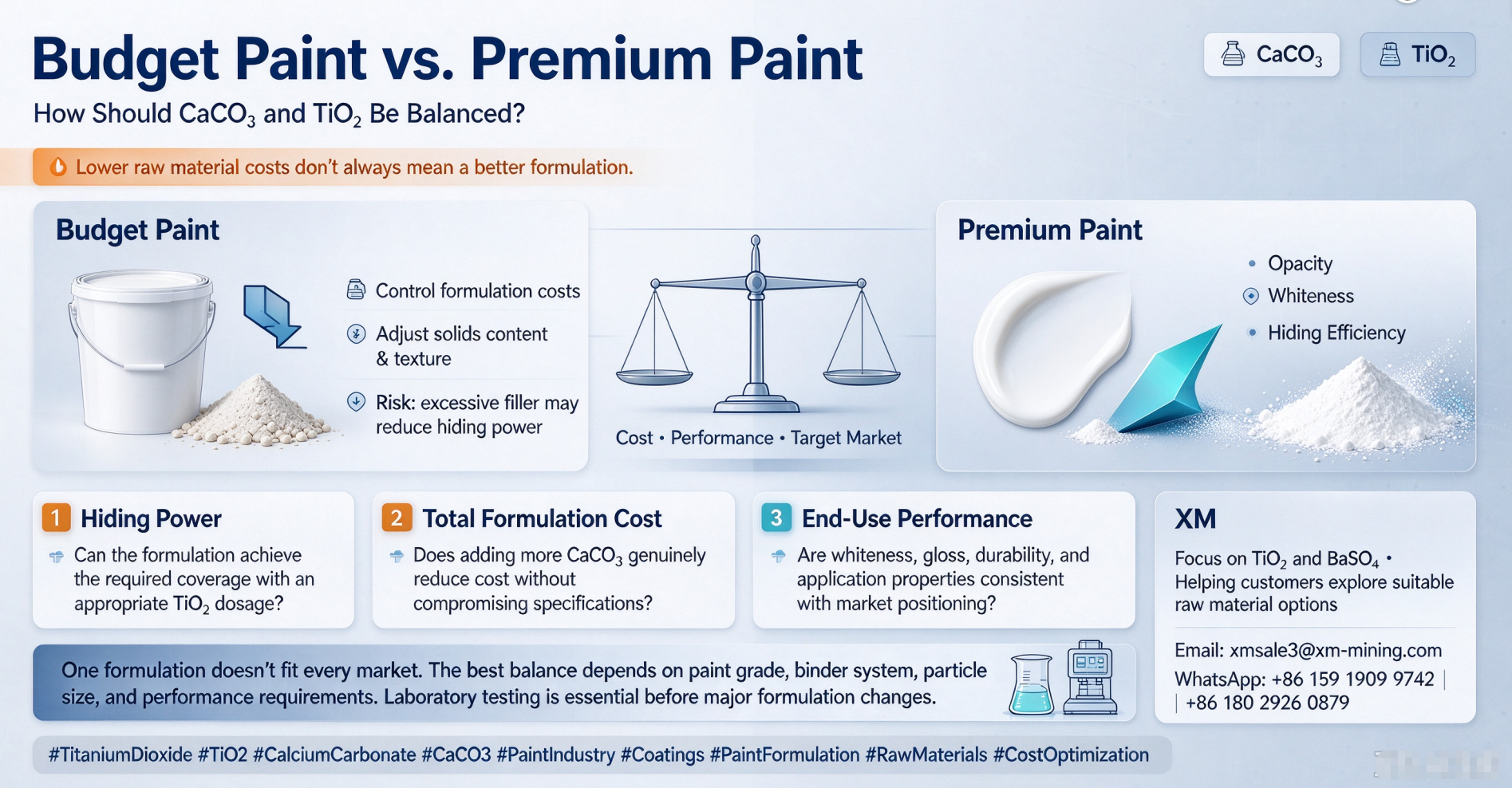
Lower raw material costs don’t always mean a better formulation.
For paint manufacturers, calcium carbonate (CaCO₃) and titanium dioxide (TiO₂) serve different purposes. The key is finding the right balance between cost, performance, and the target market.
For budget paints, calcium carbonate can help control formulation costs and adjust properties such as solids content and texture. However, excessive filler loading may reduce hiding power and affect the final finish.
For premium paints, TiO₂ plays a critical role in opacity, whiteness, and hiding efficiency. The right grade and dosage can help manufacturers achieve their desired appearance and performance.
So, how should manufacturers optimize the balance?
Rather than comparing price per ton alone, consider these three factors:
1.Hiding power: Can the formulation achieve the required coverage with an appropriate TiO₂ dosage?
2. Total formulation cost: Does adding more CaCO₃ genuinely reduce the cost without compromising product specifications?
3. End-use performance: Are whiteness, gloss, durability, and application properties consistent with the product’s market positioning?
One formulation doesn’t fit every market. The best balance depends on paint grade, binder system, particle size, and performance requirements. Laboratory testing is essential before making significant formulation changes.
At XM, we focus on titanium dioxide (TiO₂) and barium sulfate (BaSO₄), helping customers explore suitable raw material options for their applications.
What matters most in your paint formulation: raw material cost, hiding power, or the balance between the two? I’d be interested to hear how manufacturers approach this trade-off.
#TitaniumDioxide #TiO2 #CalciumCarbonate #CaCO3 #PaintIndustry #Coatings #PaintFormulation #RawMaterials #CostOptimization
Post time: Oct-22-2026